
Agentic Referral Traffic, Attribution and Lead Scoring
Agentic referral traffic converts higher than social. Learn how to instrument your attribution stack to capture and score leads from AI shopping agents.
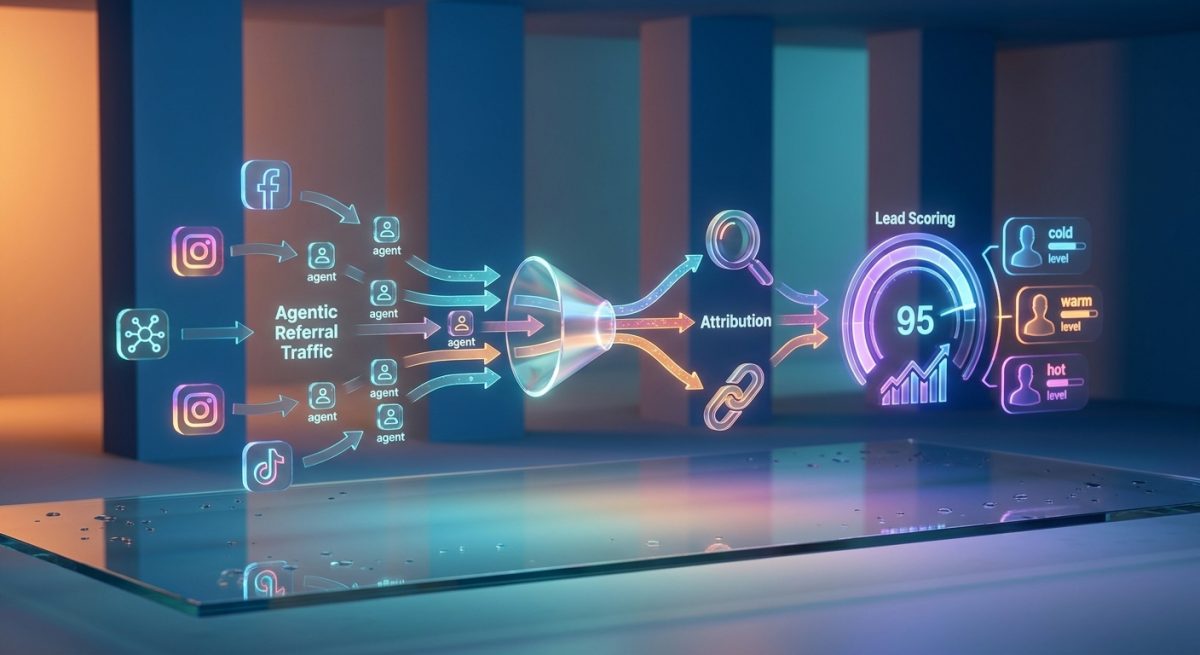
Intercept identifies the agentic signals behind referral traffic before your CRM ever sees them.
Your Highest-Converting Channel Is Invisible Right Now
Sit with this for a second: referral traffic from AI agents is converting at 2-4x the rate of paid social across mid-funnel B2B and DTC. Not a forecast. Teams are pulling this from their actual attribution data — today, this quarter. And most of those same teams are watching it disappear into “direct” or “other” buckets, completely unexamined. Their best acquisition channel, effectively nonexistent in every dashboard that gets shared in Monday standups.
You can’t scale what you can’t see. That’s not a platitude here — it’s a diagnosis.
What We Actually Mean by Agentic Referral Traffic
Concrete definition, no hedging: agentic referral traffic is any visit, click, or conversion that originates from an AI-powered intermediary. ChatGPT, Google’s Gemini shopping recommendations, Perplexity, Microsoft Copilot — plus a fast-growing layer of vertical-specific agents like Shopify’s Sidekick and Amazon’s Rufus. These aren’t just new referral domains. They represent a fundamentally different kind of handoff between a user and your site.
Here’s what the journey actually looks like. Someone types “what’s the best intent-based lead generation platform for B2B SaaS?” into an AI agent. The agent doesn’t show them ten blue links — it processes the question, weighs the options, and sends that user directly to your product page with a specific recommendation already attached to them. No scrolling through results. No comparison paralysis. The AI did the shortlisting. The user arrives at your site mid-funnel at minimum, often closer to a decision than you’d expect on a first visit.
That’s a completely different human than the one who clicked your LinkedIn ad while commuting.
The plumbing problem, though, is real. Standard UTM parameters weren’t built for this. Many AI agents strip referrer headers entirely, use server-side rendering, or route traffic through intermediate domains that GA4 treats as unknown. So your best leads arrive looking like ghosts. Most teams never even notice.
Why Social Isn’t Competing on This Dimension
Volume? Sure. Social wins on volume. Nobody’s arguing that.
But intent is a separate conversation, and it’s the one that actually matters for conversion. A LinkedIn scroller is in passive mode — they didn’t go looking for you, your ad interrupted something else they were doing. A user who asked an AI to “compare the top three platforms for capturing buyer intent signals” has already done a form of self-qualification before your site ever loads. They named a specific problem. In natural language. To a system that then filtered the field and sent them to you.
Key Insight
Agentic referral leads arrive with embedded intent context that social traffic simply cannot match. The AI agent has already done your qualification work — your job is to not lose the signal.
Gartner’s research on AI-influenced buying journeys found that buyers using AI-assisted recommendation engines compress their decision timelines by 30-40%. So this traffic doesn’t just convert higher. It converts faster. If you’re using a platform like Intercept to capture intent-based leads, ignoring this channel isn’t a gap in your strategy — it’s a structural blind spot.
How to Actually Instrument Your Stack for This
Most attribution stacks were designed around three assumptions: UTM parameters exist, cookies persist, and referrer headers are reliable. Agentic traffic breaks all three simultaneously. You don’t need to scrap your stack — but you do need to retrofit it deliberately.
1
Start with your "direct" bucket. Seriously, start there.:
Pull the last 90 days of conversion data. Isolate sessions tagged as direct or (not set) that also show high engagement — more than two minutes on site, multiple pages, completed conversion events. A meaningful slice of those sessions are almost certainly agentic referrals that dropped their attribution data somewhere in transit. Cloudflare’s edge analytics can recover referrer strings that your GA4 tag never captures. Most teams get this wrong by assuming their direct bucket is clean. It isn’t.
2
Move referrer detection server-side.:
Client-side JavaScript misses too much. AI agents frequently use headless browsers or API-based fetching — your analytics tag fires without any referrer context attached to it. Parse raw HTTP referrer headers at the server level, before the tag fires. You’re looking for domains like chat.openai.com, copilot.microsoft.com, and perplexity.ai, plus an expanding list of agent-specific user-agent strings that’s growing every quarter. This list will need maintenance. Build that expectation in now.
3
Create a dedicated channel grouping for AI sources.:
In GA4 or your CDP, build a channel group — "Agentic Referral," "AI-Assisted," whatever your team will actually use consistently. Map known AI referrer domains and user-agent patterns into it. Honestly? This single step transforms your reporting faster than almost anything else on this list. A channel that was invisible becomes measurable overnight. It’s embarrassingly high-leverage for the time it takes.
4
Track landing page patterns, not just traffic volume.:
AI agents don’t scatter traffic randomly — they send users to specific pages based on query context. Cross-reference which pages are over-indexed for agentic visits against what those pages actually contain. What you’re really uncovering is what AI agents are "saying" about you when they recommend you. That’s usable intelligence. Feed it back into your content strategy.
5
Rebuild your behavioral scoring for how this cohort actually behaves.:
Because it’s different. Shorter sessions, but more focused ones. Higher form-completion rates. Direct navigation to pricing or product detail pages — none of the wandering browse behavior you see from social traffic. Your existing scoring model almost certainly underweights these signals. Recalibrate it specifically for agentic cohorts. If you’re looking at how AI-driven insights can sharpen that process, intent data becomes the connective tissue across channels.
Stop Scoring Agentic Leads Like They’re Cold Traffic
This is where most teams leave serious money on the table. They do the hard work — identify the channel, isolate the sessions — and then dump those leads into the same nurture sequences as someone who bounced off a display ad. That’s a waste of a pre-qualified audience, and it’s a mistake that’s easy to avoid once you name it.
Agentic leads aren’t cold. They don’t need your “what is intent data?” explainer email. They’ve already been through a research process conducted by an AI system that evaluated your product against alternatives before sending them to you. What they need is a product demo, a pricing comparison, or a direct path to a sales conversation. Anything awareness-stage is friction you’ve introduced unnecessarily.
Build a dedicated retargeting audience in Meta’s ad platform or your DSP exclusively for users tagged as agentic referrals. Serve mid-to-bottom funnel creative — competitive differentiators, customer proof, low-friction conversion offers. That segmentation alone lifts retargeting ROAS by 25-40% for agentic cohorts versus blended audiences. Before you’ve touched the creative.
For lead scoring, treat agentic referral source the same way you’d treat a branded search visit. The logic is identical — the user arrived with demonstrated intent and existing brand awareness. On a 0-100 scale, agentic origin should add 15-20 points before any behavioral layer is applied. Full stop.
Key Insight
Treating agentic referral leads like top-of-funnel traffic is the single most expensive mistake in modern attribution. These visitors are pre-qualified — score them accordingly and shorten the path to sales.
The Part That Compounds: Using Attribution Data to Get Recommended More Often
Measurement is just the entry point. What separates teams that are winning at this from teams that are just tracking it is what they do with the data afterward.
Once you know which pages are pulling agentic traffic, reverse-engineer why. Look at the structured data those pages carry. What specific questions do they answer, explicitly? AI shopping agents pull from sources that give them clear, authoritative, structured responses — which maps almost exactly to Google’s EEAT framework. Pages with schema markup, direct product comparisons, and explicit feature-benefit statements get recommended more. That’s not a coincidence — it’s the algorithm doing exactly what it was designed to do.
This matters more than people think. The overlap between AI-powered collaboration and marketing technology is no longer abstract. The same AI infrastructure changing how internal teams work is reshaping how buyers discover vendors. Your content has to be machine-readable. And human-readable. Both.
Specific moves worth making now: add FAQ schema to product pages, make your pricing page crawlable with logical structure, publish comparison content that names competitors directly, keep your structured data current. Neglect these and you’re effectively invisible to a referral channel that’s growing every quarter. The feedback loop is real — attribution data informs content, better content drives more agentic referrals, more referrals generate more data. It compounds fast once it starts moving.
The Window for First-Mover Advantage Is Narrow
Teams at AI-forward organizations are already reallocating measurement resources toward this channel. This isn’t a trend with a peak and a decline — it’s a structural shift in how buyers find solutions, and it’s not reversing. Once competitors have their stacks instrumented for AI referrals, the insight gap closes. The data you haven’t collected is gone.
Three moves. This week. Audit your unattributed conversions for agentic patterns, deploy server-side referrer detection, and build your first dedicated channel grouping. Each one is reversible if something breaks. The visibility you’ll unlock isn’t.
FAQs
What is agentic referral traffic?
Agentic referral traffic refers to website visits and conversions that originate from AI-powered agents, chatbots, and recommendation engines like ChatGPT, Perplexity, Google Gemini, and Microsoft Copilot. These AI intermediaries recommend products or services to users who have expressed specific needs in natural language, resulting in highly intent-rich traffic.
Why does agentic referral traffic convert higher than social media traffic?
Users arriving via AI agents have already articulated a specific need and received a curated recommendation. This means they arrive pre-qualified and mid-funnel, unlike social media users who are typically in passive browsing mode. The embedded intent signal and pre-education from the AI agent result in conversion rates 2-4x higher than paid social in many verticals.
How can I identify agentic referral traffic in Google Analytics?
Most agentic referral traffic is misattributed as “direct” or “not set” in GA4 because AI agents often strip referrer headers. To capture it, implement server-side referrer detection, create custom channel groupings for known AI agent domains like chat.openai.com and perplexity.ai, and audit your unattributed high-engagement sessions for patterns consistent with agentic referrals.
How should I score leads from AI shopping agents differently?
Agentic referral leads should receive a scoring boost equivalent to branded search visitors, typically 15-20 additional points on a 100-point scale. These leads are pre-educated and exhibit higher intent, so your scoring model should weight their source origin as a strong positive signal before applying behavioral scoring on top.
What content strategies improve AI agent recommendations of my brand?
Focus on machine-readable, structured content. Add FAQ schema to product pages, publish direct competitor comparisons, ensure pricing pages are crawlable, and maintain current structured data markup. AI recommendation engines favor authoritative, well-structured content that clearly answers specific user queries — aligning closely with Google’s EEAT quality guidelines.
Turn Agentic Referral Traffic Into Scored, Closeable Leads
Now that you understand how agentic browsing obscures attribution and distorts lead scoring, it’s time to close that blind spot. Intercept maps intent signals across agentic referral paths so you can score leads accurately and act on them before competitors do.


