
Google Gemini DV360 vs Meta AI, Predictive Media Buying
Compare Google Gemini in DV360 vs. Meta's AI ad engine for predictive intent-based media buying — and learn how to exploit the gaps between them.
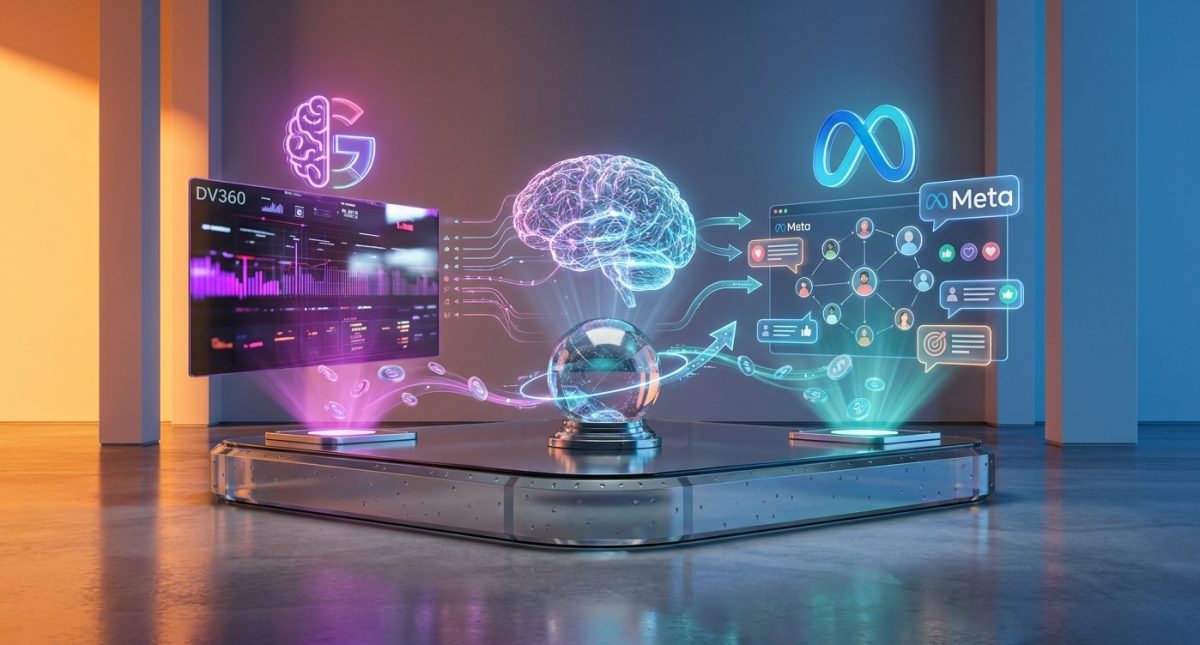
See how Intercept bridges Gemini DV360 and Meta AI to capture buyers before rivals do.
The Predictive Media Buying Arms Race Nobody’s Talking About
Here’s a number that should make every media buyer uncomfortable: Statista reports that global programmatic ad spend has surpassed $700 billion, yet the average click-through rate on display ads still hovers around 0.1%. The platforms promising AI-driven efficiency keep taking more budget. The results? Incremental at best. Google’s integration of Gemini into DV360 and Meta’s continuously evolving AI ad engine represent the two most ambitious attempts to fix this — through predictive intent-based media buying. But they solve fundamentally different problems, fail in predictable ways, and create exploitable gaps that sophisticated marketers can arbitrage right now.
How Gemini Powers DV360’s Predictive Engine
Google didn’t just bolt Gemini onto DV360 and call it a day. The integration restructured how the platform processes bid signals, audience construction, and creative optimization into a unified inference layer. Gemini’s multimodal reasoning capabilities mean DV360 can now interpret search query context, YouTube watch patterns, and browsing behavior simultaneously — triangulating purchase intent rather than relying on single-signal proxies.
The practical impact shows up in three areas. First, audience expansion got smarter. Instead of lookalike modeling based on demographic overlap, Gemini builds what Google internally calls “intent graphs” — behavioral maps that predict not just who is likely to convert but when they’re entering a decision window. Second, automated bidding now accounts for cross-channel momentum. A user who searched for “enterprise CRM comparison” on Tuesday, watched a Salesforce review on YouTube Wednesday, and visited G2 on Thursday gets bid up aggressively on Friday — not because of retargeting, but because Gemini models the trajectory. Third, creative asset selection became dynamic in ways that go beyond simple A/B testing; the system matches ad format, messaging tone, and CTA type to inferred funnel position.
Where does it fall short? Transparency. DV360’s Gemini layer operates as a near-total black box. You can see performance outcomes, but reverse-engineering why the model made a specific bid decision is almost impossible. For teams that need to report granular attribution to a CFO, this is a real problem — not a theoretical one.
Key Insight
Google's Gemini integration in DV360 excels at cross-channel intent triangulation, but its opacity makes it nearly impossible to audit why specific bid decisions were made — a critical blind spot for performance marketers who need defensible attribution.
Meta’s AI Ad Engine: A Different Philosophy Entirely
Meta’s approach to predictive media buying starts from a fundamentally different premise. Where Google builds intent models from open-web behavior, Meta builds them from social graph density and engagement velocity. The platform’s AI engine — powered by its Advantage+ suite and underlying recommendation models — doesn’t need to infer intent from search queries. It reads it from behavior patterns that users don’t even realize they’re producing.
Think about what Meta actually knows. It tracks not just that someone liked a post about project management tools, but how long they hovered, whether they screenshot it, if they sent it to a colleague in Messenger, and whether they then visited a competitor’s Instagram profile. That behavioral exhaust feeds a prediction engine that’s eerily accurate for certain verticals — particularly D2C, mid-market SaaS, and anything with an emotional purchase trigger.
Meta’s Advantage+ Shopping campaigns and its broader AI creative tools have effectively automated campaign structure. You feed the system a product catalog, creative assets, and a conversion objective. It does the rest. And for many advertisers, “the rest” performs 20-30% better than manually configured campaigns.
But Meta’s engine has a glaring weakness: it’s a walled garden that optimizes within its own ecosystem. The AI cannot see what’s happening on Google, on Reddit, on your website beyond the pixel. It’s predicting intent based on a rich but fundamentally incomplete picture. When a B2B buyer is deep in a research phase across multiple channels, Meta often misreads casual content engagement as high intent — burning budget on users who are months away from a decision.
Where Each Platform Actually Wins
Google Gemini in DV360 wins when:
- Your buyer journey spans multiple channels and touchpoints over weeks or months
- Search intent data is a strong predictor of conversion (B2B, high-consideration purchases, professional services)
- You need programmatic access to premium inventory beyond social — CTV, audio, native, DOOH
- Your attribution model depends on cross-channel path analysis
Meta’s AI ad engine wins when:
- Purchase decisions are emotionally driven or impulse-adjacent
- Your creative is your competitive advantage (video-first, UGC-heavy, visually rich products)
- You’re optimizing for speed-to-scale rather than precision targeting
- Social proof and peer influence are meaningful conversion drivers
Neither platform wins across the board. The marketer who insists on choosing one over the other is leaving money on the table.
The Gaps — And How to Arbitrage Them
Here’s where it gets interesting. The failures of each platform create opportunities that neither can address alone. The gap between Google’s intent triangulation and Meta’s social-graph inference is where the most valuable signals live — and where most marketing teams have zero coverage.
Consider a concrete scenario. A VP of Marketing at a mid-market company searches “demand generation platforms” on Google (captured by DV360’s intent model), then two days later engages with a LinkedIn thread about lead quality challenges (invisible to both platforms), then visits a Reddit comparison thread (partially visible to Google, invisible to Meta), and finally clicks a Meta retargeting ad a week later. Both platforms will claim credit. Neither actually understood the full journey.
This is precisely the problem that Intercept was built to solve. By monitoring intent signals across platforms that neither Google nor Meta can see — Reddit threads, Quora questions, LinkedIn discussions, niche community forums — Intercept captures the buying signals that fall into the cracks between walled gardens. It’s not replacing DV360 or Meta; it’s filling the blind spots that make both platforms’ AI less effective than they could be.
Key Insight
The most valuable intent signals in B2B and high-consideration B2C don’t live inside Google or Meta — they live in Reddit threads, LinkedIn comments, and niche community discussions. The marketers who capture these signals first gain an asymmetric advantage.
1
Map the Signal Gaps:
Audit where your buyers discuss, compare, and evaluate solutions outside Google and Meta’s ecosystems. Reddit, LinkedIn, G2, Capterra, and industry Slack communities are common blind spots.
2
Layer Intent Data Across Platforms:
Use third-party intent signals to inform — not replace — your DV360 and Meta campaigns. If someone is actively asking about your category on Reddit, that signal should elevate their priority in both platforms’ bid models.
3
Time Your Platform Spend to Funnel Stage:
Use DV360 for mid-funnel research phases when cross-channel behavior is the strongest signal. Shift budget to Meta when social proof and creative persuasion matter most — typically late-funnel or for re-engagement.
4
Validate AI Decisions Against Real Conversations:
Check what both platforms’ AI models tell you about your audience against what buyers are actually saying in open forums. The latest insights from platforms like Intercept can reveal intent patterns that neither algorithm surfaces.
What the Data Says About Blended Approaches
Research from Forrester consistently shows that multi-platform media strategies outperform single-platform approaches by 30-40% on cost-per-acquisition metrics. But “multi-platform” doesn’t mean running the same campaign on both Google and Meta. It means understanding the unique predictive strengths of each system and orchestrating them deliberately.
Gartner’s latest marketing technology research reinforces this: CMOs who invest in signal integration across platforms report significantly higher confidence in their attribution models and budget allocation decisions. The AI isn’t the bottleneck — the data fragmentation between platforms is.
This is why the arbitrage opportunity exists. Google and Meta are both building increasingly powerful prediction engines, but they’re building them in isolation. Every signal that falls between them is a signal you can capture first. Tools focused on intent-based lead generation exist specifically to exploit this structural gap — turning the invisible middle of the buyer journey into actionable pipeline.
Stop Comparing Platforms. Start Connecting Signals.
The head-to-head comparison between Gemini in DV360 and Meta’s AI engine is the wrong frame. Both are impressive. Both are incomplete. The winning strategy isn’t choosing between them — it’s building a signal layer that connects what each one sees to what neither one can. Start by auditing where your buyers go that neither platform tracks, and work backward from there.
FAQs
What is predictive intent-based media buying?
Predictive intent-based media buying uses AI models to analyze behavioral signals — search queries, content engagement, browsing patterns — to predict when a user is entering a purchase decision window. Platforms like Google DV360 and Meta use these predictions to automate bid adjustments, audience targeting, and creative selection in real time.
How does Google Gemini improve DV360 ad performance?
Gemini enhances DV360 by enabling multimodal reasoning across search, video, and browsing signals simultaneously. This allows the platform to build intent graphs that predict not just who is likely to convert, but when they are entering a decision phase — leading to more precise bid timing and creative matching.
Is Meta’s Advantage+ better than Google DV360 for B2B marketing?
Generally, no. Meta’s Advantage+ excels for emotionally driven, visually rich, and impulse-adjacent purchases. For B2B marketing, where buyer journeys are longer and span multiple channels, Google DV360’s cross-channel intent modeling typically delivers stronger results. However, Meta can complement a B2B strategy for brand awareness and retargeting.
What are the biggest blind spots in Google and Meta’s AI ad systems?
Both platforms operate as walled gardens and cannot see buyer activity outside their ecosystems. Intent signals from Reddit, LinkedIn discussions, Quora, G2 reviews, and niche industry communities are invisible to both — yet these are often where high-value buyers actively research and compare solutions.
How can marketers arbitrage the gaps between Google DV360 and Meta?
Marketers can capture intent signals from platforms neither Google nor Meta monitors — such as Reddit, LinkedIn, and industry forums — and use those signals to inform bid strategies and audience prioritization across both platforms. Layering third-party intent data on top of each platform’s native AI creates a more complete picture of the buyer journey.
Stop Guessing Which AI Platform Wins Your Buyers
You just explored how Google Gemini DV360 and Meta AI differ in predictive media buying—now put both ecosystems to work with unified intent signals. Intercept identifies high-intent buyers across programmatic and social channels, letting you allocate spend to the winning platform before your competitors react.


